


Freight has always been essential to supply chains. What has changed is the scale, speed, and scrutiny under which it operates. E-commerce growth, warehouse expansion, and evolving regulations have reshaped how goods move through regions.
At the same time, many communities are paying closer attention to traffic, safety, and emissions impacts from freight. For logistics real estate owners and operators, that convergence has raised the stakes. Decisions about where to build, how to design access, and which infrastructure improvements to support now carry long-term financial, operational, and reputational consequences. These decisions carry even greater weight now that many first- and last-mile e-commerce freight facilities are moving nearer to where people live, work, and shop.
Yet many of those decisions are still made with incomplete or outdated freight data and models. This incomplete understanding of freight travel and needs results in assumptions about truck patterns, port reliance, or freeway access that persist long after freight networks have changed. The result is avoidable risk: underperforming sites, misaligned infrastructure investments, and strained community relationships.
When freight planning improves, those risks become manageable. With a clearer understanding of how trucks actually move, businesses can site facilities more strategically, prioritize the right infrastructure, and build stakeholder confidence around capital investments.
Freight Planning Has Become a Core Business Strategy
Freight planning has become critical in part because it was neglected for so long. For years, many metropolitan planning organizations (MPOs) developing travel models either did not prioritize freight modeling or did not do it at all. In some regions, there was no current freight model to rely on. Freight was not studied with the same rigor as personal auto travel.
Meanwhile, retail brick-and-mortar had been declining for years. Then COVID hit, and e-commerce sales surged. US retail e-commerce increased roughly 73 percent from early 2020 through 2023. That shift translated into substantial freight and logistics demand even as many other sectors saw declines. Almost overnight, everyone became reactive instead of proactive. Yet the underlying data infrastructure was not there. There had not been the data collection, market research, or travel behavior studies for freight that the industry relies on for passenger travel.
Consider the contrast. The ITE Trip Generation Manual provides detailed benchmarks for personal travel. For warehouses and logistics facilities, there are only a handful of studies, all pre-COVID. There is still very little post-COVID data. As a result, when agencies or businesses review a warehouse project, they often lack reliable or recent information. Without better data, they cannot accurately estimate trip generation, truck types, travel patterns, or infrastructure needs.
As a backdrop to this uncertainty, truck volumes have continued to grow. Case in point: A couple years ago, there were roughly two million commercial trucks driven on California roads alone. That number is almost certainly higher now. Trucks represent a larger share of vehicles on the road than they did 10 or 20 years ago, operating in communities that are simultaneously paying closer attention to impacts.
Viewed together, it has become a perfect storm. COVID accelerated e-commerce. Amazon and other platforms expanded rapidly. Freight activity surged. Yet planning tools and trip generation data lagged behind.
For logistics real estate operators, that gap is no longer theoretical. Freight planning is not just a compliance exercise. It affects where to site a facility, how to design access, how to prioritize infrastructure, and whether a logistics park remains fully occupied and profitable over the long term. Freight planning is now a core business strategy.
The Real Freight Network Looks Different Than You Think
One of the most consistent surprises in freight planning is how little stakeholders know about the markets or areas freight facilities in their region are actually serving. In many cases, it simply has not been studied closely.
A common assumption is that warehouse traffic is primarily port-driven. In California’s Central Valley, many believed most trucks were moving to and from the Port of Oakland. When detailed mobility data was analyzed, the results told a different story. Only about 10 percent of trips interacted with the port.
Ten percent versus ninety percent fundamentally changes how you think about roadway priorities and infrastructure investments. When those findings were tested directly with warehouse operators, the response was straightforward. They were not there to serve the port. Warehouses near the port handled that function. These facilities were positioned to interact with the East, sending trucks to Chicago, Texas, New Mexico, and Arizona.
Assumptions about freight flows often rely on intuition rather than observed behavior. Without current data, it is easy to assume proximity to a port or freeway explains everything. In reality, modern logistics networks are more distributed and complex.
Another blind spot is trip structure. Long-haul freight has historically received the most attention, supported by established datasets. But medium-distance trips, particularly those tied to sorting and first- and last-mile facilities, are less understood. Facilities that receive goods, sort them, and send them to long-haul or last-mile destinations create patterns not captured by simple origin-destination summaries.
First- and last-mile activity is gaining attention, but medium-distance sorting trips remain underexamined. Yet these trips often drive local congestion and shape where pressure shows up on arterials and interchanges.
When the full network is visible, including long-haul, medium-distance, and last-mile movements, the freight system looks very different. Once those patterns are clear, infrastructure priorities often shift.
Why Warehouse Siting Decisions Fail Without Freight Intelligence
Many companies make warehouse siting decisions based primarily on economics, which makes sense from a business perspective. The focus has been simple: identify a site, recover the investment quickly, and move on. In that scenario, planners are not always at the table.
Cheap land near a major freeway can appear strategic on paper or through an economic lens. But that approach does not account for where trucks are coming from, where they are going, how they access the national network, or how operations function day to day.
When freight origins and destinations are not studied, siting becomes guesswork. Facilities may sit near a freeway but be poorly connected to routes that matter most to tenants. Access constraints, interchange capacity, local roadway conditions, and lack of planned/funded future infrastructure improvements can undermine what looked like a strong location.
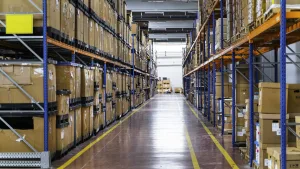
The results show up over time. Speculative warehouses built without a pre-existing tenant or lease agreement and placed primarily where land was inexpensive often struggle to remain fully occupied. They may lease initially but are harder to keep filled. Facilities sited with careful analysis of truck patterns and existing and future network access tend to remain fully occupied and consistently profitable.
The difference affects tenant retention, operating costs, and long-term asset value. A logistics park designed with a clear understanding of how freight moves can support efficient operations for decades. One built primarily on land cost and basic freeway proximity may face persistent challenges.
As freight networks grow more complex, siting decisions require more than a map and a pro forma. Without freight intelligence grounded in observed data, the risk of misalignment increases, along with the cost of getting it wrong.
The Risk of Relying on Single-Source Freight Data
There is no perfect data source. That should be the starting point for any serious freight analysis. Yet vendors often present their platforms as complete solutions. In reality, freight data is powerful but limited, inferential, and shaped by how it is processed.
Many mobility datasets begin as device pings with latitude, longitude, an anonymous ID, and a timestamp. From trillions of these points, algorithms infer home and work locations, origins and destinations, intermediate stops, and sometimes household characteristics by linking the inferred home location to census data. The engineering is sophisticated. It is still inference.
Privacy protections add another layer. Data must be cleaned, anonymized, and aggregated. That process can remove detail in ways that materially affect planning outcomes and findings.
Connected vehicle data introduces further constraints. Sample sizes can be small. The data is typically auto-only and often skews toward higher-income vehicle owners. If an analysis involves disadvantaged communities or specific vehicle classes, portions of the network may not appear in the data stream.
To be clear, these datasets have value. But they cannot be treated as plug-and-play answers. They are tools in a toolbox. Before using any dataset to guide multimillion-dollar capital decisions, leaders must ask basic questions:
- What is the source of the data?
- What is the sample size?
- How is it expanded to represent the population?
- How do privacy rules affect visibility?
- How might coverage gaps bias results?
If vendor outputs are used alone and directly for major investment decisions, risk follows. The real value comes from understanding limitations, calibrating against observed conditions, integrating multiple sources, and applying professional judgment. Without that rigor, confidence may be misplaced and errors costly.
From Freight Analytics to Defensible Investment Decisions
The ultimate goal of freight analysis is confidence. For leaders making major capital expenditure decisions, lengthy technical memos are rarely persuasive. What resonates is clarity. Targeted presentations. Maps that show where trucks are actually moving. Visualizations and dashboards that make patterns understandable.
There is too much data to communicate in static formats. Sharing truck patterns across multiple counties through tables alone would overwhelm most audiences. Interactive tools allow stakeholders to explore patterns directly and test scenarios.
When stakeholders see that only 10 percent of trips interact with a port instead of the assumed majority, conversations change. Showing medium-distance sorting trips alongside long-haul flows helps decision-makers clarify infrastructure priorities. When scenario testing shows how a new interchange, roadway alignment, or charging site affects network performance, decisions become more defensible.

This is where freight analytics becomes strategy. By calibrating data to real-world conditions, integrating sources, and translating findings into clear narratives, it becomes possible to build a shared fact base.
Approvals move more quickly when impacts are transparent. Infrastructure investments are easier to justify when grounded in observed freight patterns. Electrification planning becomes more realistic when dwell time, tour feasibility, and vehicle class differences are accounted for rather than assumed.
Better freight planning does not eliminate trade-offs. It replaces speculation with evidence. Grounding decisions in a clear view of how goods and workers move helps operators, agencies, and communities align around solutions that work.
Freight Intelligence as Strategic Infrastructure
Freight networks are evolving faster than many planning frameworks can keep up. The businesses best positioned for long-term success are those that seek clarity before committing capital. They invest in understanding real-world freight movement, not legacy assumptions or single-source outputs. Through disciplined mobility data analytics, calibration to observed conditions, and scenario testing grounded in operations, they reduce risk in siting, infrastructure prioritization, and electrification planning.
That clarity depends on custom tools and visualizations that translate complex freight systems into actionable insight. When teams ground freight planning in rigorous analysis and communicate it transparently, operators protect asset value and improve efficiency, public agencies gain confidence in investments, and communities see more targeted solutions. When freight planning improves, everyone wins.
····························
RSG brings together deep expertise in freight movement, advanced freight modeling, and hands-on mobility data analytics to help logistics operators and public agencies make confident, data-driven decisions. We do not rely on a single dataset or a one-size-fits-all model. Our team collects and integrates freight data, calibrates models to observed conditions, and applies rigorous validation to ensure that capital investments, siting strategies, and infrastructure plans are grounded in reality. By combining proprietary tools, industry-leading datasets, and custom visualizations, we deliver insights few firms can match.
Want to understand how freight is really moving through your region? Connect with Kevin Johnson today to start turning freight intelligence into smarter, more defensible decisions.