
As energy infrastructure evolves and communities grow more sensitive to environmental impacts, acoustics is becoming an increasingly important part of project planning and design. From data centers and battery energy storage systems (BESS) to emerging technologies like drones and advanced air mobility (AAM), developers are facing novel questions about how sound affects both operations and surrounding communities.
To explore these issues, we spoke with Indi Savitala, RSG’s Head of Acoustics. With more than two decades of experience working on building acoustics and utility/energy infrastructure projects, Indi specializes in translating complex acoustic challenges into practical solutions for clients. In our conversation, he shared perspectives on emerging noise issues, the growing role of visualization in acoustics, and why involving acoustics expertise early can help projects avoid costly problems later.
Where do you see the biggest opportunity to apply data analytics and technology differently in acoustics consulting?
Many companies are building data centers as demand for AI continues to grow. You also see companies cropping up that act as connectors, meaning that if you’re a landowner and want to lease your land for a data center but don’t know where to start, there are now firms that help facilitate that.
As a result, we see significant opportunities in applying the analytics we use for outdoor sound propagation modeling to the data center market. In essence, we would be providing the types of acoustics and noise control engineering services we already offer, but on a much larger scale.
Looking ahead, I also envision acoustics consulting becoming much more visual and experiential. We already place sound sources on maps and show how far sound propagates with color contours, but those visualizations will continue to evolve.
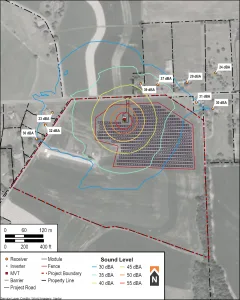
That could include 3D visualizations or the use of augmented reality (AR), where you could stand on a property line, put on glasses, see where something like a transformer will be located and hear what it sounds like. Instead of just reading about decibel levels, people could experience the sound and hear the difference between existing conditions and what mitigation might achieve.
How can early involvement from acousticians help shape design decisions so that sound performance becomes an asset rather than a last-minute fix?
Involving our acoustics team early creates additional benefits for the client.
A recent project I contributed to highlighted a more common outcome when we’re brought in later. In that case, we were consulted at the construction documents stage, where the room layouts and floor plans were already fixed, so we couldn’t offer much input. One key constraint was restrictive wall thicknesses, which meant we had to get creative about achieving high STC (sound transmission class) ratings in a very thin wall design.
When acoustics is considered earlier, those design parameters are still flexible. I’ve been involved in projects from the very beginning, even during the pre-proposal stage when teams are still interviewing for the work, and those tend to be the most successful because they’re highly collaborative.
At that stage, acoustics becomes an asset and can even save clients money. We can help guide decisions such as how mechanical systems are laid out or how equipment such as fan coil units are distributed within a space. Coordination between the architect and mechanical engineer is much easier when those choices are still being shaped.
The bigger point is that acoustics should be on everyone’s radar, both for clients and for architectural, planning, and engineering teams during the bidding process. Many clients understand it’s important but don’t always include it explicitly in the procurement, even though addressing sound early almost always saves money compared with waiting until it becomes a problem.
How can advanced noise analytics help battery energy storage and data center developers address community concerns and secure permits?
One of the challenges with projects such as battery energy storage systems (BESS) and data centers is that local codes and ordinances typically focus on a single parameter that has to be achieved at the property line, usually expressed in dBA. But what we capture is a much broader range of sound across different frequencies.
Low-frequency noise is something I’ve found especially interesting since joining RSG. We have a large database of measurements from projects going back decades, and what we’re seeing is that low-frequency noise can be a real issue with BESS, but it’s often overlooked.
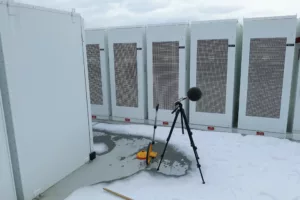
Part of the reason is that it’s not always clear what equipment should be used to capture it or how it should be analyzed. That’s where RSG has a real advantage. We have the right equipment, the analytical capability, and decades of data demonstrating our ability to capture and analyze these patterns.
That depth of experience allows us to help clients better understand potential noise issues and address them before they become problems with permitting or the surrounding community.
RSG collects large amounts of noise data in the field. How do you turn that raw data into insights that help clients make better decisions?
One of the things we’re actively working on is speeding up the process from sound measurement to usable insights. Right now, data can live in different places, so even finding and organizing it can be part of the challenge before you begin analyzing it.
Once that data is accessible, the real value comes from applying our experience to identify patterns and share what we learn. That could mean presenting conference papers, writing blog posts, or highlighting issues we’re seeing, such as low-frequency noise or other parameters that may eventually influence how noise codes evolve.
Another important piece is how we communicate the data. Visualization plays a big role. Clear graphics and visualizations often communicate insights far more effectively than raw measurements or tables.
Where should developers focus their attention when it comes to noise, and how can stronger acoustic analysis reduce risk before a project reaches the public hearing stage?
One issue that came up repeatedly at a recent conference I attended is how difficult it’s becoming to secure power connections for new data center projects. Getting a facility connected to the grid can take years, especially for large data center developments. Because of that timeline, developers are starting to look for alternative ways to power projects.
One example I heard about involved a data center company bringing generators on flatbed trucks to power parts of their site. Those trucks run 24 hours a day. It allowed them to get the facility operational in a matter of months, but it also creates a lot of noise and air pollution.
Another example involved using decommissioned jet engines to generate power. These engines still function; they’re retired because the aircraft have reached the end of their service life. With the right setup, they can be used similarly to traditional generators.
As developers search for alternative power solutions, noise and other environmental impacts are becoming bigger concerns for surrounding communities. This is where acoustics expertise can help teams understand potential impacts and design mitigation strategies such as sound walls or improved generator enclosures.
Many developers still see acoustics as something to address only if a complaint arises. But conditions vary widely depending on location, project design, and local regulations, and understanding potential impacts early can help prevent problems that might otherwise lead to community opposition or permitting delays.
Which emerging technology do you think will most disrupt acoustics analysis in the next three to five years?
Drone and advanced air mobility (AAM) noise will likely be one of the most disruptive areas for acoustics.
We know drones create some noise, but their noise profiles are not all the same. Drones vary by the number of propellers, propeller sizes, and the volume of air movement.

If we can get ahead of these technologies and start analyzing those patterns (through research, measurements, and modeling) we can better understand their noise profiles. Drones aren’t going away. In many cases they’re extremely valuable, such as delivery systems bringing medicine to remote areas.
The goal isn’t to limit that technology, but to understand its impacts. If we can quantify the noise and communicate what people should expect, that adds real value for communities and developers as these technologies become more common.
What’s a common misconception about acoustics in renewable energy projects that you would challenge?
In my career, I’ve come across two long-standing misconceptions.
The first is that acoustics is a “nice to have.” I enjoy challenging that idea because, when it comes to siting and permitting, acoustics is often essential. Even if it’s not listed as a specific requirement for the project, having reliable noise data can help protect a project from potential complaints later on.
The second misconception is that the return on investment with acoustics consulting isn’t there. Sometimes people assume that bringing in an acoustics team will lead to costly recommendations that add thousands or even millions of dollars to a project.
In reality, the opposite is often true. The data consistently shows that it’s far more expensive to fix a noise problem after a project is built than it is to address it early. Bringing in a qualified acoustician early in the process can help identify practical solutions and connect project teams with the right expertise to prevent issues before they turn into community complaints.
····························
Energy and infrastructure projects are becoming more complex, with acoustics playing a growing role in permitting, design, and community acceptance. If you’re facing noise-related challenges or want to better understand potential impacts early, we’re here to help. Contact us to learn how RSG can support your next project.