
The Puget Sound Regional Council (PSRC) has long deployed household travel surveys to understand how people move across King, Kitsap, Pierce, and Snohomish counties. Taking their existing travel survey program a step further, PSRC wanted to examine a related question that traditional travel data and crash reports alone could not fully answer: How do attitudes around safety and security shape the trips people make, avoid, or modify? To help answer that question, RSG conducted the PSRC Safety and Security Survey, a focused add-on to the region’s household travel survey program.
The Challenge
Crash data is essential for planning, but it is reactive. It tells agencies where reported crashes occurred, who was involved, and what happened after something went wrong. It does not capture the near-misses that leave people shaken, the harassment that makes someone avoid transit, the high-speed traffic that discourages bicycling, or the longer, more expensive routes people choose because they do not feel safe.
Importantly, this type of work requires a much broader definition of safety. Traffic crashes matter, but so do near-misses, personal security concerns, perceived risks, public beliefs about what causes crashes, and the emotional burden of traveling while worried or on alert. Without this information, PSRC and its partner agencies would have an incomplete view of what keeps people from using certain modes, reaching certain destinations, or feeling comfortable while traveling.
RSG’s Solution
Working with PSRC and researchers at the Georgia Institute of Technology, RSG designed and administered a web-based survey that leveraged two respondent sources: people who had completed the most recent household travel survey and agreed to future research, and newly recruited households reached through address-based sampling. This approach allowed PSRC to build on its existing travel survey program while expanding the sample to improve geographic and demographic representation.
The survey asked about general travel attitudes, walking/rolling, bicycling, transit, emotional travel safety burden, practical travel safety burden, traffic crash experiences, near-misses, personal security concerns, and sociodemographic characteristics. This framework moved the analysis beyond whether people had experienced unsafe travel conditions to show how those experiences actually changed behavior.
The findings made clear why this broader lens matters. Across the region, 94% of residents reported experiencing at least one unsafe travel event. Near-misses were the most common experience, reported by 79% of residents, followed by personally experiencing a traffic crash and witnessing a traffic crash, both at 67%. These findings gave PSRC visibility into safety experiences that often do not appear in crash datasets but can still shape how people travel.
The survey also showed that safety concerns translate into real travel consequences. Nearly half of residents said safety concerns affect their travel choices, and 44% said they avoid certain modes of transportation because of safety concerns. While 79% of residents said they feel safe in their day-to-day travel, 45% worry about being in a traffic crash, 41% worry about their own safety while driving, and only 16% said they would be comfortable bicycling with many cars around them. These findings helped PSRC understand the gap between general feelings of safety and the specific concerns that can limit active transportation, transit use, and multimodal travel.
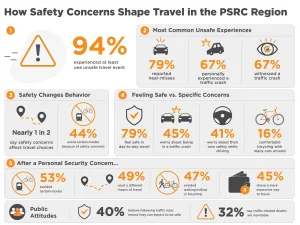
Personal security emerged as one of the clearest examples of safety affecting access. Among those who had experienced a personal security concern, 53% avoided certain modes because of safety concerns, 49% used a different means of travel, 47% avoided walking/rolling or bicycling for trips, and 45% selected a more expensive way to travel because of fear of assault, harassment, or harm from others. For PSRC, these findings showed that safety concerns can increase costs, reduce travel options, and limit access even when no crash has occurred.
The survey also gave PSRC insight into public beliefs about transportation safety. Only 40% of residents felt that following traffic rules meant they could expect to be safe on the road, while 32% believed traffic-related deaths are an inevitable part of traveling. At the same time, 68% associated pedestrian deaths with people wearing dark colors, while only 28% believed speed limits are set too high in some places. These results can help PSRC and its partners understand where public attitudes align with, or diverge from, traffic safety engineering principles.
By capturing what residents experienced, worried about, avoided, and paid more in travel time and costs to navigate around, RSG helped PSRC develop a rich database to document safety concerns within their region. Importantly, this safety-focused survey demonstrated how agencies can incorporate safety and security into existing data collection programs such as household travel surveys. For agencies outside the PSRC region, the project offers a model for turning safety from an after-the-fact measure of what went wrong into a forward-looking tool for understanding what people need to travel with confidence.
Download a PDF