

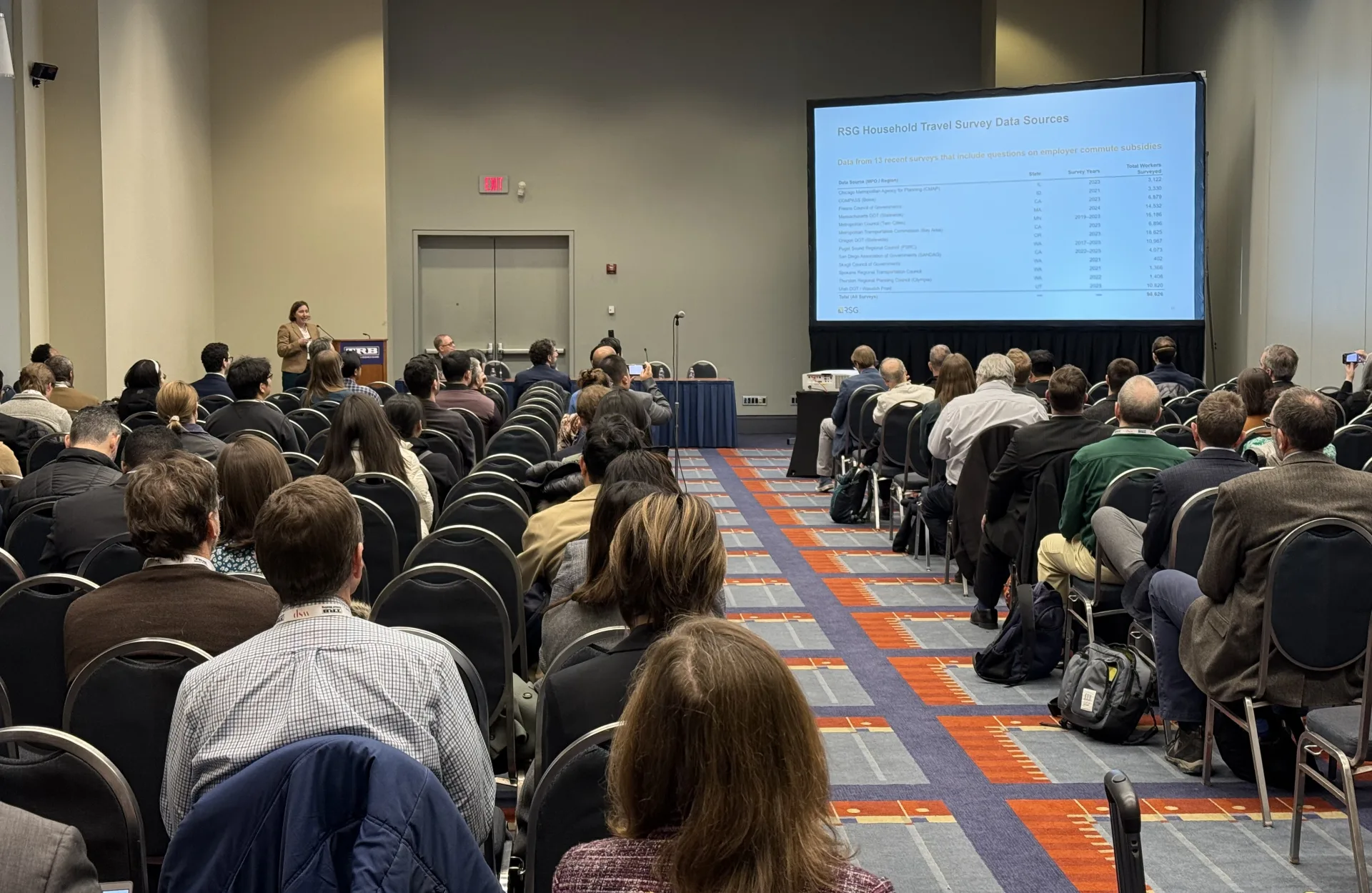
RSG recently joined thousands of transportation professionals in Washington, DC, for the 2026 Transportation Research Board (TRB) Annual Meeting. Throughout the week, RSGers attended workshops and poster and lectern sessions, participated in committee meetings, and connected with peers across the industry, engaging in conversations that spanned research, policy, and real-world application.
Drawing on those conversations, this article highlights several themes that stood out most to our team. Across topics ranging from artificial intelligence to safety, mobility data, and advanced air mobility (AAM), discussions repeatedly returned to questions of implementation, usefulness, and how emerging ideas will translate into practice. These reflections connect what RSGers heard at TRB with the kinds of challenges our clients are navigating today.
Artificial intelligence is gaining momentum, but its role remains supportive
Artificial intelligence was a recurring topic at this year’s TRB Annual Meeting, though among RSG staff, the tone felt thoughtful rather than breathless. While AI appeared across many sessions and posters, most discussions focused more on its future potential than on examples of current applications in transportation planning.
“There was energy around it,” as one attendee put it. At the same time, our attendees noted that many AI-focused presentations emphasized theory or system design without clearly tying those approaches back to the kinds of decisions agencies are making today. Other attendees shared a similar reaction, observing that much of the AI research presented still feels one step removed from practice.
Rather than expecting continued rapid breakthroughs, the group largely agreed that AI’s near-term role is more likely to be incremental, driving greater efficiencies and supporting deeper insights across teams. Where it resonated most was in its ability to support planners by improving how data are handled. “The question for me,” one attendee explained, “is what AI will do to help us generate data and how that data can be used.”
Participants pointed in particular to opportunities for AI to assist with tasks such as data coding, imputation, and quality control. These are areas where efficiency and consistency matter, but where human judgment remains essential. That perspective mirrors how RSG is already applying AI to improve the accuracy and consistency of survey response coding, helping analysts spend more time on interpretation and insight. In that sense, the TRB conversations reinforced a broader takeaway: AI appears most useful when it strengthens existing planning workflows rather than attempting to replace them.
Mobility data is most valuable when paired with context and judgment
Mobility data, particularly passively collected data, was another recurring theme across TRB sessions. Among RSG staff, however, the focus was less on access to data and more on how to interpret and apply the data. While many presentations highlighted new data sources and analytical techniques, speakers repeatedly returned to a familiar challenge: mobility data alone often does not deliver the insights needed to make important planning decisions.
“There’s a lot of conversation happening around data fusion,” one attendee noted. But at this year’s TRB, presenters increasingly highlighted concrete examples of data fusion done well. Several presentations demonstrated thoughtful approaches to combining mobility data with traditional survey data, showing how each source can fill gaps left by the other. Rather than signaling an area still struggling to mature, these sessions suggested that the field is beginning to apply data fusion techniques in more intentional, decision-focused ways, offering useful models for how practitioners, including those of us at RSG, might continue to build on this work.
Another attendee emphasized that passively collected data often lacks important context sought by planners. “You can see what’s happening,” they said, “but you don’t always know why.” Without information on trip purpose, traveler characteristics, or constraints, mobility data can raise as many questions as it answers.

Our attendees also noted that agencies are becoming more sophisticated (and more skeptical) consumers of mobility data. Rather than being swayed by a data source’s volume or novelty, clients are increasingly asking how different data sources compare, where they align or conflict, and what trade-offs exist. As one attendee framed it, the real value lies in understanding the strengths and limitations of each dataset and not treating any single source as the definitive truth.
These conversations echoed how RSG approaches mobility data with our clients: integrating multiple data sources with household travel surveys and other contextual information to support clearer, more defensible decisions. The prevailing message from TRB was that the next phase of mobility data work will require even more discipline by developing repeatable methods, clearly communicating uncertainty/limitations around each data source, and staying grounded in how people actually travel through survey data collection.
Safety discussions called attention to perception as much as performance
Safety was a prominent topic at this year’s TRB Annual Meeting, but for many RSG staff, the most meaningful conversations focused less on new metrics and more on how travelers experience safety. Across sessions, attendees returned to the idea that traditional safety data (such as crashes or incidents) only tells part of the story.
Much of the research presented at TRB reinforced well-established patterns, including differences in how people perceive risk by gender, travel mode, and time of day. While not necessarily new, these findings remain important for shaping transportation systems that people feel comfortable using.
Several attendees emphasized the value of collecting data that captures how travelers perceive safety, particularly for active modes and transit. As one RSGer noted, whether people feel safe can be just as important as whether a facility or service is statistically safe, especially when agencies are trying to encourage walking, biking, or transit use.
The discussion also highlighted how assumptions about safety don’t always align with evidence. One example that stood out involved fare-free transit. Despite common concerns, presenters shared findings suggesting that fare-free policies do not increase crime and may reduce conflict by removing fare enforcement from the boarding process. For several attendees, this reinforced the importance of pairing perception data with empirical analysis.
Overall, the conversations at TRB underscored a consistent takeaway: improving safety requires more than counting crashes. It requires understanding lived experience and using that insight to inform design, policy, and communication.
Advanced air mobility planning is becoming an airport operations issue
Advanced air mobility (AAM) felt less speculative at this year’s TRB Annual Meeting than in past years. For RSG staff attending AAM-related sessions, the conversation shifted from whether AAM will materialize to how airports might integrate it into existing airfield and airspace systems.
“There was a lot more focus on operations this year,” one attendee noted. Sessions examined how AAM activity could affect runway capacity, airfield efficiency, and surrounding communities. Rather than treating AAM as a stand-alone technology, presenters increasingly framed it as something airports will need to plan around, often with limited guidance and evolving policy frameworks.
Several sessions explored the implications of AAM for airport capacity and performance, including case studies that highlighted potential conflicts with traditional aviation operations. As one attendee observed, the challenge for airports is figuring out how to accommodate new types of aircraft without degrading what’s already working.

Policy and planning also featured prominently, with presentations on regional and state-level AAM efforts underscoring the growing expectation that airports will play an active role in shaping deployment. Sessions emphasized early planning around vertiport siting, ground access, community impacts, and safety, which are areas already familiar to airport operators.
Our attendees also noted increased attention to modeling and simulation tools designed to test how AAM might interact with existing airfield and airspace operations. These themes align with RSG’s recent ACRP synthesis work, which similarly emphasized that successful AAM integration will depend less on technology alone and more on careful planning, coordination, and realistic assessments of operational trade-offs.
Bridging research and practice remains a defining challenge for the field
Across many TRB sessions, a familiar tension surfaced repeatedly: the gap between what research makes possible and what practice can realistically support. While TRB continues to showcase increasingly sophisticated methods, speakers frequently returned to a more basic question: whether those approaches help practitioners make better decisions.
Several attendees noted that modeling complexity continues to increase, particularly in areas such as autonomous vehicles, energy transitions, and demand uncertainty. But complexity itself was not viewed as a virtue. As one attendee put it, the focus should remain on using the right tool for the right question, rather than defaulting to the most advanced approach available.
That sentiment carried across discussions of AI, mobility data, safety, and advanced air mobility. In each case, attendees emphasized the importance of transparency, interpretability, and usability. These are qualities that can be lost when methods outpace agencies’ ability to apply or explain them.
For many RSGers, TRB reinforced that bridging the gap between research and practice is not a one-time effort, but an ongoing responsibility of practitioners. As new tools and data sources continue to emerge, the transportation profession will need to stay focused on enabling informed, practical decision-making, ensuring that innovation ultimately serves the needs of agencies, operators, and travelers.
For RSG, TRB offered a valuable opportunity to reflect on how emerging research aligns with the real-world questions our clients are facing and where careful, experience-driven judgment continues to matter most.
····························
RSG was a proud Silver Patron of the 2026 Transportation Research Board Annual Meeting and was honored to present on topics ranging from travel forecasting to emerging technologies such as autonomous vehicles. If you have questions or would like to connect with the RSG team members who attended and presented at TRB, we invite you to contact us to continue the conversation.